

NB8 Series of Topical Briefs: Geo-economic Resilience
In this new policy brief series, the eight leading institutes of the Nordic-Baltic Eight countries commit to closer collaboration on analysis and research. The aim is to deepen understanding of the evolving security, political, and societal dynamics shaping the Nordic–Baltic region amid renewed great-power competition.
The Nordic-Baltic Eight series of jointly published topical briefs is a collaboration between the eight leading institutes in the Nordic–Baltic region. The initiative aims to enhance understanding of the region’s shifting security, political, and societal landscape in an era of renewed great-power rivalry. The series seeks to generate shared insights, foster informed policy dialogue, and contribute to the region’s strategic resilience.
The views expressed in the policy briefs are those of the author(s) and do not necessarily reflect the positions of the participating institutes. New briefs will be published on a continuous basis as they are released.
The eight institutes involved are:
The Swedish Institute of International Affairs (UI),
Danish Institute of International Studies (DIIS),
The Finnish Institute of International Affairs (FIIA),
The Icelandic Institute of International Affairs (IIA),
The International Centre for Defence and Security (ICDS),
The Institute of International Relations and Political Science at Vilnius University (TSPMI),
The Latvian Institute of International Affairs (LIIA),
and
The Norwegian Institute of International Affairs (NUPI)
Publications
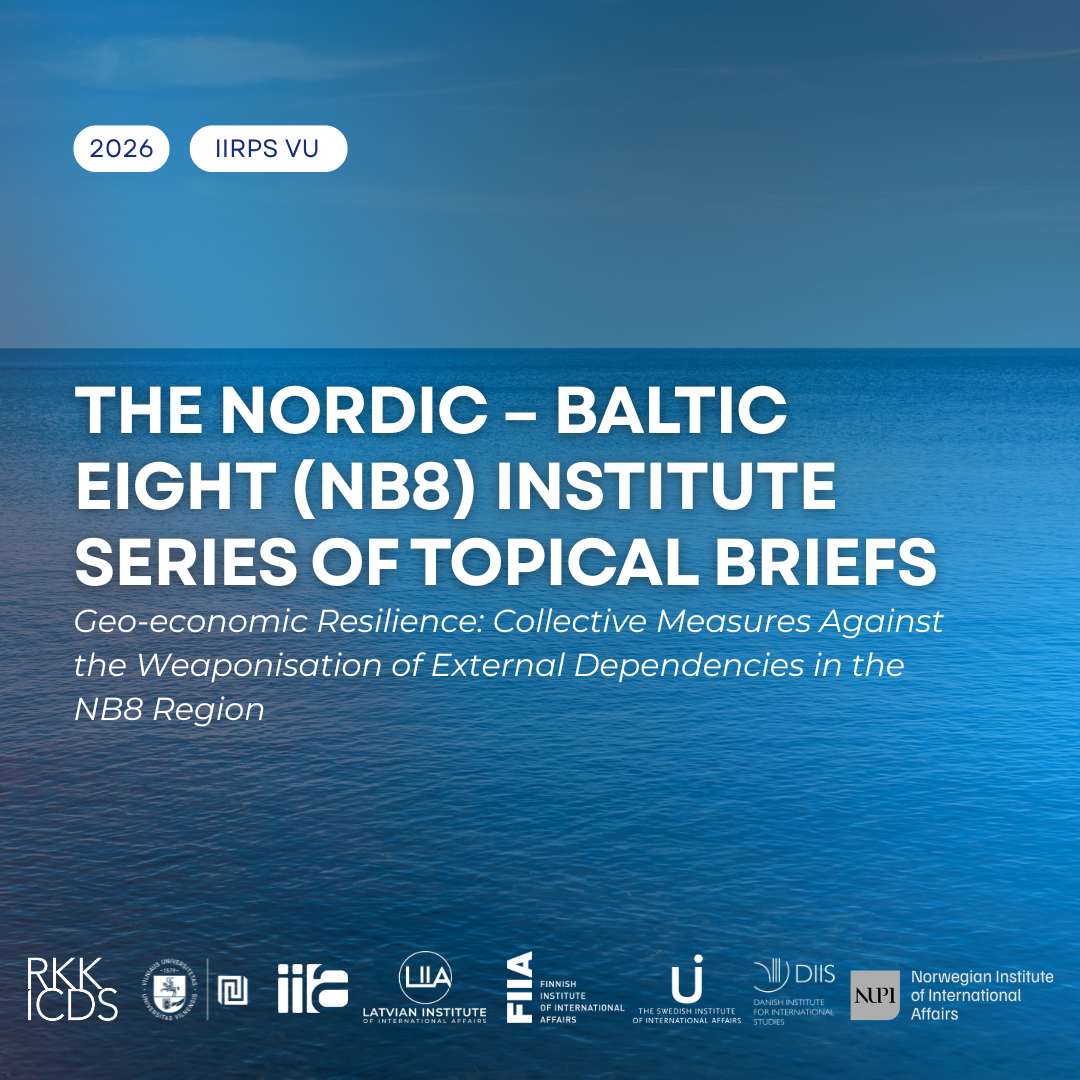
Brief No. 3 – 22 May 2026
Geo-economic Resilience: Collective Measures Against the Weaponisation of External Dependencies in the NB8 Region
Geo-economic competition and the coercive use of economic statecraft are increasingly replacing the rules-based system of liberal economic exchange. Small and open economies such as the NB8 states are particularly vulnerable in this context, as external dependencies can be weaponised as a means of pressure. This policy brief proposes ways in which NB8 countries can prepare for such scenarios and outlines collective measures to strengthen the region’s geo-economic resilience.