

NB8 Series of Topical Briefs: China’s Green Statecraft and NB8 Arctic Security
In this new policy brief series, the eight leading institutes of the Nordic-Baltic Eight countries commit to closer collaboration on analysis and research. The aim is to deepen understanding of the evolving security, political, and societal dynamics shaping the Nordic–Baltic region amid renewed great-power competition.
The Nordic-Baltic Eight series of jointly published topical briefs is a collaboration between the eight leading institutes in the Nordic–Baltic region. The initiative aims to enhance understanding of the region’s shifting security, political, and societal landscape in an era of renewed great-power rivalry. The series seeks to generate shared insights, foster informed policy dialogue, and contribute to the region’s strategic resilience.
The views expressed in the policy briefs are those of the author(s) and do not necessarily reflect the positions of the participating institutes. New briefs will be published on a continuous basis as they are released.
The eight institutes involved are:
The Swedish Institute of International Affairs (UI),
Danish Institute of International Studies (DIIS),
The Finnish Institute of International Affairs (FIIA),
The Icelandic Institute of International Affairs (IIA),
The International Centre for Defence and Security (ICDS),
The Institute of International Relations and Political Science at Vilnius University (TSPMI),
The Latvian Institute of International Affairs (LIIA),
and
The Norwegian Institute of International Affairs (NUPI)
Publications
Brief No. 6 – 23 October 2026
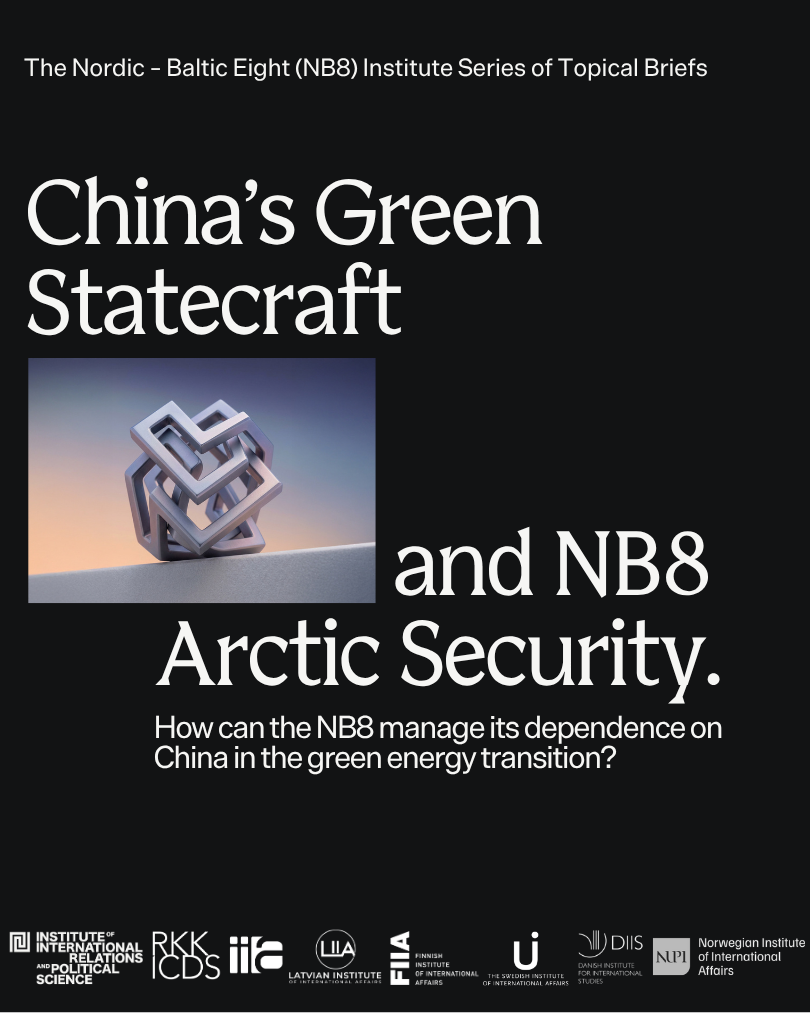
How can the Nordic-Baltic Eight (NB8) manage their growing dependence on China in the green energy transition?
The sixth publication in the NB8 Series of Topical Briefs examines how China’s dominance in clean energy technologies and critical mineral processing creates new strategic vulnerabilities for the Nordic-Baltic region.
This policy brief explores the intersection of green energy security, economic dependence and China’s growing interests in the Arctic.
The authors argue that green energy security and Arctic security should be addressed within a common strategic framework. They propose coordinated NB8 measures to diversify supply chains, strengthen regional cooperation and reduce long-term strategic dependence on China.
The publication is part of a joint initiative by eight leading Nordic-Baltic research institutes, aimed at deepening understanding of the region’s evolving security challenges and strengthening its strategic resilience.
Read the full publication below.