

From IIRPS VU to Japanese Institutions: A Student’s Experience in the MIRAI Programme
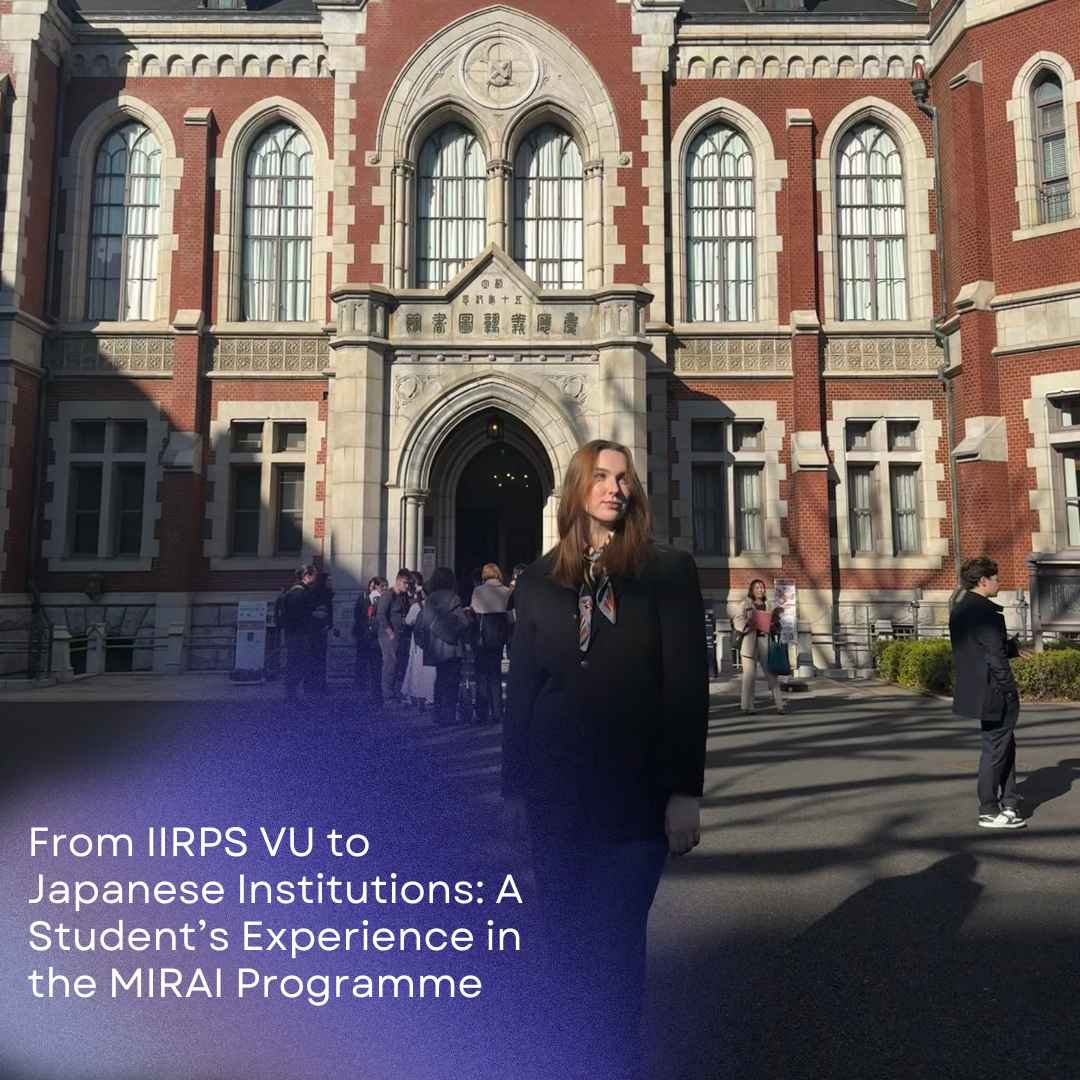
At the beginning of the year, Milda Ščiglaitė, a second-year student in the MA programme in International Relations and Diplomacy at IIRPS VU, took part in the international MIRAI programme, during which she represented both Lithuania and the Institute in Japan. The aim of the visit was not only to gain a closer understanding of Japanese culture, but also to deepen her knowledge of the country’s security policy, the principles of diplomacy, and the importance of international cooperation.
During the programme, participants visited key Japanese institutions, where they had the opportunity to learn more about the country’s foreign and security policy priorities. Visits were organised to Japan’s Ministry of Foreign Affairs and Ministry of Defense, where the country’s main strategic goals, regional security challenges, and Japan’s role in the international arena were presented. These experiences provided a better understanding of how Japan’s foreign and defense policy is shaped, as well as the significance of soft power in today’s world.
An important part of the programme was also the opportunity to become acquainted with Japan’s academic environment. Meetings at Keio University in Tokyo with Professor Yuichi Hosoya and Professor Michito Tsuruoka offered valuable academic insights into Japan’s regional security challenges. During the visit, participants and university students discussed the changing global security order and possible scenarios in the Indo-Pacific region. Meanwhile, at the National Museum of Territory and Sovereignty, participants were able to gain a deeper understanding of how issues of statehood, territorial integrity, and historical memory are presented in Japan.
Equally significant was the visit to the JICA Ogata Sadako Research Institute for Peace and Development, where Milda learned more about Japan’s approach to human security, international assistance, and sustainable development initiatives. This visit highlighted how Japan combines its political, humanitarian, and diplomatic objectives in a global context.
Alongside the official programme, participants also had the opportunity to experience Japan culturally. MIRAI participants visited Mount Fuji and explored its importance in Japanese history, culture, and national identity. They also visited the famous Tokyo Tower, the National Museum, and various districts of Tokyo, which offered a close-up view of the country’s cultural diversity and the interplay between tradition and modernity.
According to the student, the trip became an exceptional opportunity not only to broaden her academic and professional knowledge, but also to experience Japan firsthand as a country where culture, history, diplomacy, and security policy are closely intertwined. “Participating in the MIRAI programme was an incredibly valuable international experience for me, allowing me to meaningfully represent Lithuania and IIRPS VU in an international setting. I am grateful to the organisers, the Embassy of Japan in Lithuania, and my Institute for their trust and for the opportunity to experience this wonderful country. I am certain that the subjects I study contributed greatly to my understanding of Japan’s security policy and diplomacy, while I myself was able to contribute to productive discussions during the programme,” Milda said.
About the programme
This programme is a short-term youth exchange initiative organised by the Japan International Cooperation Center (JICE), aimed at inviting undergraduate and graduate students, as well as young professionals, from Europe, Central Asia, and the Caucasus who study politics, security policy, economics, international relations, Asian studies, Japan studies, or other related fields.
The programme is called “MIRAI,” from the Japanese word mirai (pronounced approximately “mee-rye”), meaning “future.” According to Japan’s Ministry of Foreign Affairs, the programme offers an excellent opportunity to:
- promote mutual understanding,
- enhance intellectual discussions,
- build strong networks among the future leaders of Japan and the world.
In this way, the programme contributes to strengthening the relationship between Japan and the countries of the regions mentioned above.